Showing posts with label God. Show all posts

Monday, July 8, 2013

John Calvin and the Trinity

Over the past month, I have set out to read through John Calvin's Institutes of the Christian Religion


As I have been reading this phenomenal defense of orthodox Christianity, I can understand now why it has stood the test of time.  The thoroughness, richness, reverence, and simplicity of style which Calvin wrote the Institutes makes it a foundational book of systematic theology for the Christian layman and minister alike!

I currently am in the middle of Calvin's section on the Trinity and I wanted to share some of the quotes which impacted me the most.

To begin with, it should be stated why we must study the Trinity.  Calvin says,

"Moreover, Satan, in order to tear our faith from its very roots, has always been instigating great battles, partly concerning the divine essence of the Son and the Spirit, partly concerning the distinction of the Three Persons.  He has during nearly all ages stirred up ungodly spirits to harry orthodox (true and right) teachers over this matters and today also is trying to kindle a new fire from the old embers.  For these reasons, it is important...to resist the perverse ravings of ungodly men."  (Book 1, pages 144-145)

Mormons, Muslims, and Jehovah's Witnesses anyone?  In order to stand strong for the truth against our sometimes well-equipped opponents, we have to "know our stuff".  If you need more reasons, check out my earlier post about 10 reasons to study the Trinity.

 
Additionally, whenever we probe into the mystery of the Trinity, we absolutely must maintain a strong sense of caution and reverence.  God reveals Himself to us and opens our eyes to comprehend who He is.  That said, there is a limit to what our finite minds can grasp and inevitablely every single Christian must cease his inquiry and simply believe.  Here is an excellent atittude which every student of the Trinity should possess:

"...[this] passage from Gregory of Nazianzus vastly delights me:
'I cannot think on the One without quickly being encircled by the splendor of the Three, nor can I discern the Three without being straightaway carried back to the One.'


It is always useful, when dealing with a difficult doctrine, to clearly set forth what we do affirm and confess.

"Therefore, let those who dearly love soberness, and who will be content with the measure of faith, receive in brief form what is useful to know: namely, that when we profess to believe in one God, under the name of God is understood a single, simple essence, in which we comprehend three persons...

Therefore, whenever the name of God is mentioned without particularization, there are designated no less the Son and the Spirit than the Father; but where the Son is joined to the Father, then the relation of the two enters in; and so we distinguish among the Persons." (Book 1, page 144) 

Lastly, one of the trickiest aspects of the doctrine of the Trinity is the unity of the Trinity while also maintaining the distinctness of the Persons.  Three in One, without confusion or contradiction.

                           -The Relationship of Father, Son, and Spirit-
"...this distinction is so far from contravening (conflict with) the utterly simple unity of God as to permit us to prove from it that the Son is one God with the Father because He shares with the Father one and the same Spirit; and that the Spirit us not something other than the Father and different from the Son, because He is the Spirit of the Father and the Son.  For in each hypostasis (any of the persons of the Trinity) the whole divine nature is understood, with this qualification - that to each [Person of the Trinity] belongs His own peculiar quality.  The Father is wholly in the Son, the Son wholly in the Father, even as He Himself declares, 'I am in the Father, and the Father in Me' (John 14:10)....

Augustine well and clearly expresses the cause of this diversity in another place, when he speaks as follows:

'Christ with respect to Himself is called God; with respect to the Father, Son.  Again, the Father with respect to Himself is called God; with respect to the Son, Father.  In so far as he is called Father with respect to the Son, He is not the Son; in so far as He is called the Son with respect to the Father, He is not the Father; in so far as He is called both Father with respect to Himself and Son with respect to Himself, and Son with respect to Himself, He is the same God.'

Therefore, when we speak simply of the Son without regard to the Father, we well and properly declare Him to be of Himself; and for this reason we call him the sole beginning.  But when we mark the relationship that He has with the Father, we rightly make the Father the beginning of the Son." (Book 1, pages 143-144)

I hope that these passages have increased our understanding and reverence for the awesome and mighty God whom we serve.  The hidden things (and aspects) of God and His character belong to Him.  But the revealed truths, found in Scripture alone, are for us and for our children (see Deut. 29:29) 

If you would like to find a short and condensed, but highly informative and refreshing study of the Trinity, check out Bruce Ware's book, "Father, Son, and Holy Spirit".


Tuesday, June 4, 2013

Grass, Dirt, and Dominion!

In the Scriptures, specifically in Genesis 1, we read about the Creator who made all things, seen and unseen.  Out of His own good pleasure and in His good time, He spoke the universe and all that it contains into existence.  Genesis 1:1 is a familiar verse to many, but its widespread renown does not take away from the sheer power and majesty conveyed in those ten words,

"In the beginning God created the heavens and the earth."


In the very next chapter, we discover that God filled the Earth with the trees, plants, animals, etc.  All in all, He created a world which He, being the ultimate expression of perfection, declared to be "very good".  And over this creation, God set His last created being; man.  The Scriptures tell us that,

"Then God said, 'Let Us make man in Our image, according to Our likeness; and let them rule over the fish of the sea and over the birds of the sky and over the cattle and over all the earth, and over every creeping thing that creeps on the earth.' God created man in His own image, in the image of God He created him; male and female He created them. God blessed them; and God said to them, 'Be fruitful and multiply, and fill the earth, and subdue it; and rule over the fish of the sea and over the birds of the sky and over every living thing that moves on the earth.'” (Genesis 1:26-28)
 
In these passages of Scripture we find a mission which God gave to mankind.  We call this mission the Dominion Mandate and even though sin and death have made the fulfilling of this commission arduous, we are still engaged in completing this mandate.

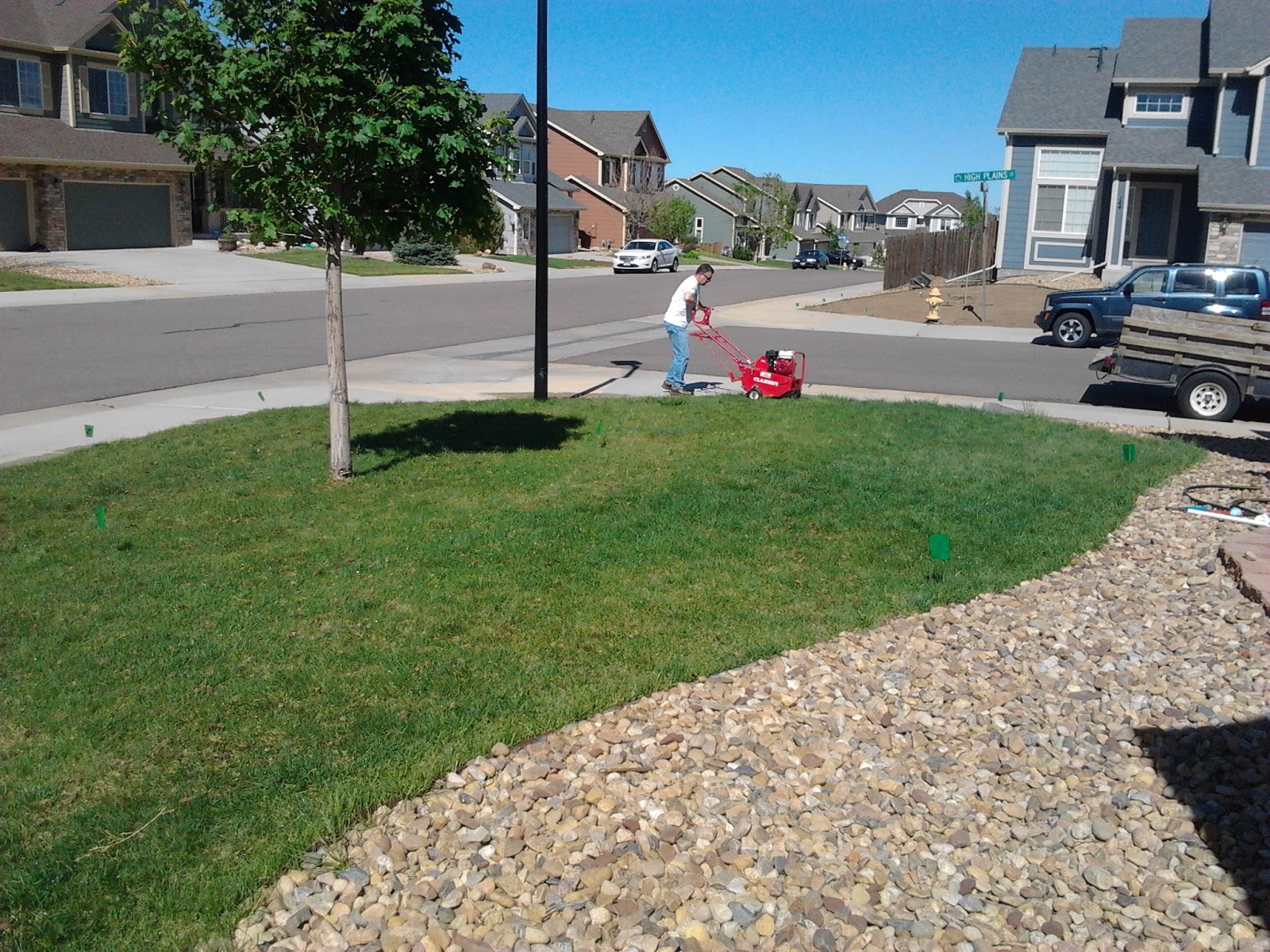
Over the past few days since I have returned home to Colorado, I have been engaged in seeking to take some dominion over our yard, in preparation for the end of our year-long lease.  The challenge was to take the yard, both front and back, from its current state of neglect and return it to its original state when we first arrived at this house in 2012. 

My first concern was the watering system.  Here in Colorado, water is less than plentiful, but the state residents do what they can to maximize the water source available to them.  Even the most amateur landscaper knows that grass needs consistent watering.  But just turning the sprinklers on doesn't answer all your problems.  My family and I soon discovered that the soil here in Castle Rock is filled with clay.  This means that the yards have to be aerated in order to allow water and other nutrients to penetrate deeper than a mere surface level.  So, the weekend project for my dad and I was to rent an aerator and start taking dominion!  Here are some of the pictures from our efforts... 

The professionals take over :)

Progress

Almost done with the backyard!

While Dad was making good progress on the lawns, I was hard at work trying to get all of our sprinklers operational.

My tools and parts for repair

The problem at hand

Working on the front yard


Our supervisor on his snazzy ride :)

Looks good from here!


This picture was his idea...

All done and ready to be taken back to Home Depot!

A freshly aerated lawn!
 With our labors accomplished for the day, my Dad and I look forward to seeing the fruit of our labors; green and luscious grass covering our front and back lawns!

God created men and women to work and to take dominion over His creation as stewards.  How are you taking dominion and caring for what God has entrusted to you?  I would challenge you, wherever you may be, to always be on the lookout for ways to act as a wise and hard-working steward over the little parcel of creation which God has given to you.

"What is man that You take thought of him, and the son of man that You care for him? Yet You have made him a little lower than God, and You crown him with glory and majesty! You make him to rule over the works of Your hands;You have put all things under his feet, all sheep and oxen, and also the beasts of the field, the birds of the heavens and the fish of the sea, whatever passes through the paths of the seas.
 
O Lord, our Lord, how majestic is Your name in all the earth!
(Psalm 8:4-9)
 

Tuesday, January 29, 2013

Dr. R.C. Sproul & Reformed Theology!

As the month of January draws to a close, I wanted to update all of our blog followers on how things are fairing for the Stanton out in Missouri.  I'm pleased to report that the pastoral internship is going very well and that we have successfully completed our second book; "The Christian Ministry" by Charles Bridges.  It was by far the most comprehensive and practical book of pastoral theology I have ever read and I'm looking forward to reading it again in the years ahead.

That said, I am also very excited about the new book the intern class is beginning.  Transitioning from pastoral theology to distinctly Reformed theology, we will be working our way through R.C. Sproul's book, "What is Reformed Theology?"

So far, we have read up to chapter 4.  I would highly recommend this book to all of you!  For one thing, Dr. Sproul has such a talent for explaining very hard and complex doctrines so very simply.  It really feels as if the whole doctrine is unfolding before your mind's eye as Sproul writes.  God has definitely given him an incredible gift of teaching ability and communication skills!

Dr. Sproul begins the book with an important distinction: what is theology? Is theology different from religion? Dr. Sproul very convincingly argues that there is a night and day difference between the study of religion and the study of theology.

"There is a profound difference between the study of theology and the study of religion.  Historically the study of religion has been subsumed under the headings of anthropology, sociology, or even psychology.  The academic investigation of religion has sought to be grounded in a scientific-empirical method.  The reason for this is quite simple.  Human activity is part of the phenomenal world.  It is activity that is visible, subject to empirical analysis...To state it more simply, the study of religion is chiefly the study of a certain kind of human behavior...The study of theology, on the other hand, is the study of God.  Religion is anthropocentric; theology is theocentric.  The difference between religion and theology is ultimately the difference between God and man." - Dr. R.C. Sproul, "What Is Reformed Theology?", pages 10-11

As Christians, we can and should study the other world religions.  One main reason why is so that we can be equipped to speak accurately when we portray the false ideas and systems of the other beliefs in this world.  But we should never equate this examination of other religions with the study of our God, who alone is the one and only true God, most blessed forever! 

After restoring that important distinction, Dr. Sproul reminds his readers that Reformed theology is unique in that it "applies the doctrine of God relentlessly to all other doctrines, making it the chief control factor in all theology."  Every doctrine that has been marked as being part of the systematic Reformed doctrine is formed in light of the doctrine of who God is and how He has revealed Himself to us.  Predestination, sovereignty, perseverance of the saints, total depravity, limited atonement (or as Sproul likes to call it, Christ's Purposeful Atonement), and the infallibility and inerrancy of Scripture all stem from and are built off of the doctrine of God.

One final lesson that I learned from Dr. Sproul which I wanted to share with you all, was the ways in which we make statements about God.  Dr. Sproul taught that there are three ways in which the Church makes declarative statements about God:

1) Way of Negation (via negationis) - Defining something by saying what it is not.  An example of this is the declarative statement that God is infinite.  By this statement, because we are finite, we declare what God is not (God has no end and no beginning) since we cannot express what infinity is positively.  Therefore we make negative assertions (infinite is not....).
2) Way of Affirmation (via affirmatas) - Defining something by making positive assertions.  An example of this is the declaration that God is holy, sovereign, and just.  These are all positive assertions of God's character.
3) Way of Eminence (via eminentia) - Defining or describing God by elevating His communicable attributes (the attributes which He created us to be able to imitate, i.e. justice, mercy, truthfulness) to the ultimate degree.  As an example, we say that God is the perfect expression of truth, love, holiness, and righteousness.

I hope these excerpts from Dr. Sproul's book have been helpful and instructive!  As I mentioned before, I would highly recommend this book both to the new student of Reformed theology, but also to the person who has been in the Reformed camp for many years.  This book will provide a refreshing review and explanation of the doctrines which makes us distinct and biblically sound.  Since we know that the human heart is a factory of idols, pumping out vain imaginations as fast as the day is long, we need to be constantly studying who God is because, as John Calvin said,

"So long as we do not look beyond the earth, we are quite pleased with our own righteousness, wisdom, and virtue; we address ourselves in the most flattering terms, and seem only less than demigods.  But should we once begin to raise our thoughts to God, and reflect what kind of Being He is, and how absolite the perfection of that righteousness, and wisdom, and virtue, to which, as a standard, we are bound to be conformed, what formerly delighted us by its false show of righteousness, will become polluted with the greatest iniquity; what strangely imposed upon us under the name of wisdom, will disgust by its extreme folly; and what presented the appearance of virtuous energy, will be condemned as the most miserable impotence."

"The people who know their God will display strength and take action." - Daniel 11:32